Tuesday Was Butcher Day, Thursday Was the Dairy: How Americans Shopped Before the Supermarket Swallowed Everything
On a Wednesday morning in 1922, a housewife in Milwaukee might leave home with a basket and a mental checklist that reads less like a shopping list and more like a travel itinerary. The butcher on the corner for the week's meat. The bakery two blocks over for bread, because nobody with any sense baked every day. The dairy for milk and butter. The dry goods store for flour, sugar, and coffee. And possibly a stop at the greengrocer if the season was right and she felt like carrying more weight home.
This was grocery shopping in America before the supermarket. It wasn't a single errand — it was a morning's work, sometimes longer. And for most of American history, it was simply what feeding a family required.
Today, Americans spend an average of around 40 minutes on a grocery run, according to consumer research, and that includes the parking lot. We emerge from a single building with everything from ribeyes to cough syrup to motor oil. The compression of what used to be a major logistical undertaking into a single, mildly tedious errand is one of the most underappreciated transformations in everyday American life.
The Neighborhood as a Distribution Network
The pre-supermarket shopping landscape wasn't random. It was a finely tuned local economy where specialization was the whole point.
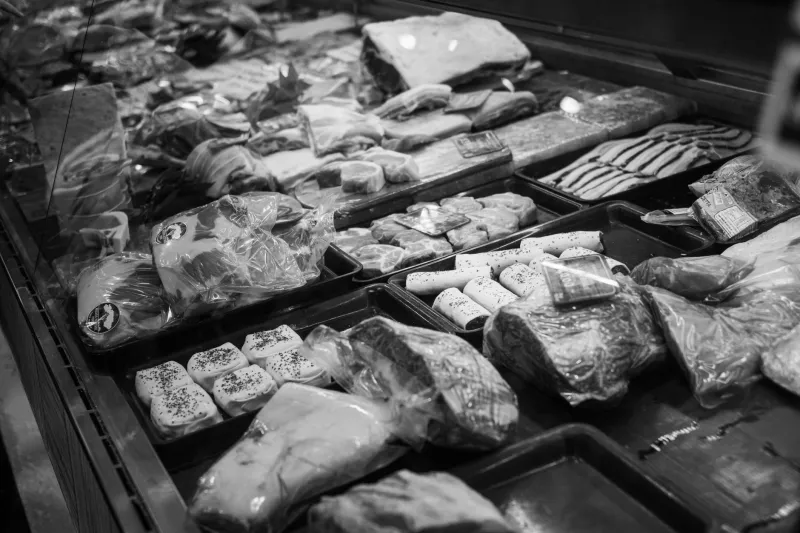
The butcher shop was a serious operation. The man behind the counter — and it was almost always a man — received whole animal carcasses, broke them down himself, and knew his inventory in a way that no modern meat department employee could replicate. If you wanted a specific cut, he could produce it. If you weren't sure what to do with a piece of meat, he'd tell you. He also knew your family's preferences, probably your budget, and would sometimes extend informal credit during hard times.
The same depth of knowledge existed at the bakery, the dairy, and the general dry goods store. These weren't interchangeable retail slots — they were specialists, often with decades of accumulated expertise in a single category. The relationships between shopkeeper and customer were long-term, personal, and loaded with mutual obligation.
For working-class families in urban areas, these shops were also deeply embedded in ethnic neighborhood life. Italian neighborhoods had their own butchers and bakers. German communities had theirs. Jewish neighborhoods on the Lower East Side of Manhattan had a dense network of kosher specialists whose entire business model was built around religious requirements that a general store couldn't accommodate. The shopping circuit wasn't just commerce — it was community infrastructure.
The Economics of Inefficiency
All of this was, by any modern measure, wildly inefficient. Multiple trips, multiple transactions, multiple relationships to maintain. Prices that varied by shop and by relationship. No standardized packaging, no consistent unit pricing, no way to comparison shop across categories in a single visit.
For women, who did the overwhelming majority of household shopping in this era, it consumed a substantial portion of the week. Daily shopping was common, partly because refrigeration was limited and fresh food didn't keep, and partly because the small-scale shops couldn't accommodate the kind of bulk buying that a modern household might do. You bought what you needed for a day or two and came back.
The financial consequences were real. Without price transparency across categories, it was difficult to manage a household budget with precision. Shopkeepers had significant pricing power, particularly in neighborhoods where residents were unlikely to travel far for alternatives. The informal credit systems that helped families through lean weeks also created debt relationships that could be uncomfortable to navigate.
None of this was experienced as a crisis — it was simply the texture of daily life. But it represented a genuine cost in time, energy, and money that accumulated across millions of households.
King Kullen and the Big Idea
The supermarket concept didn't emerge from a corporate boardroom. It was essentially invented by a single ambitious grocery manager named Michael Cullen, who in 1930 opened what is widely considered the first true supermarket — King Kullen — in a former garage in Jamaica, Queens.
Cullen's insight was almost offensively simple: put everything in one large space, price it lower than the specialty stores by buying in massive volume, and let customers serve themselves rather than waiting for a clerk to retrieve items. The self-service model was crucial. It slashed labor costs and, unexpectedly, increased sales — customers browsing on their own tended to buy more than customers who had to ask for each item.
The format spread rapidly through the 1930s, accelerated by the Depression, which made low prices an existential priority for American families. By the time World War II ended and suburban America began its great expansion, the supermarket was becoming the dominant retail form. The new suburbs were built around cars, and cars made the big-box grocery store — with its parking lot and its ability to consolidate a week's shopping into a single trip — the obvious solution.
The specialty stores didn't disappear overnight. But they retreated. The neighborhood butcher held on longest, particularly in urban areas with strong ethnic food traditions. But one by one, through the 1950s and 60s, the economic logic of the supermarket made the old fragmented model increasingly difficult to sustain.
What the Consolidation Cost
The efficiency gains were real and significant. Time saved, money saved, the sheer convenience of a single stop — these were genuine improvements in daily life, particularly for women whose domestic labor burden was already crushing.
But something else dissolved along with the inefficiency. The relationships between shopkeeper and customer that had defined neighborhood commerce for generations didn't transfer to the supermarket aisle. The butcher who knew your family's preferences was replaced by a styrofoam tray in a refrigerated case. The baker who'd been in the same location for thirty years was replaced by a bread aisle stocked by a regional distribution network.
The knowledge that lived inside those specialty shops — the craft knowledge of the butcher, the baker's feel for the season's flour — largely evaporated. It didn't move into the supermarket. It just stopped being commercially necessary.
Today, there are signs of reversal. Farmers markets, specialty butcher shops, and artisan bakeries have made a significant comeback in American cities and suburbs — often at premium prices, marketed as a return to something more authentic. People pay extra for the experience that their great-grandparents would have considered simply ordinary Tuesday morning shopping.
The irony is rich. What was once a logistical burden is now a lifestyle choice. What was once inefficiency is now a luxury.