The Store That Was Also a Restaurant, a Beauty Salon, and Somehow an Entire Afternoon
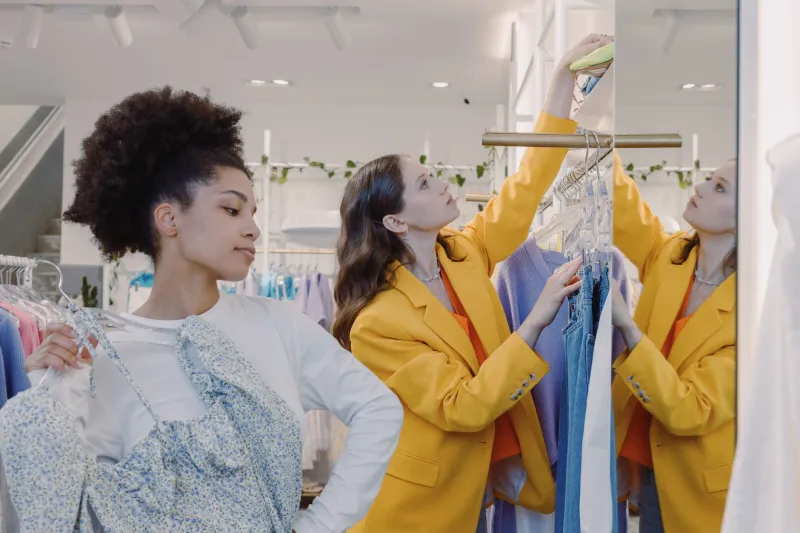
There's a particular kind of American afternoon that no longer really exists. It involved putting on decent clothes, driving or taking the streetcar downtown, and walking through a set of heavy revolving doors into a building that smelled like perfume and new fabric and something indefinably prosperous. You might have been there to buy a coat. You might have been there to have lunch. You might have been there for no reason at all except that it was Saturday and this was simply what Saturday looked like.
The mid-century American department store wasn't a store in the way we use that word today. It was closer to an institution — part retail, part theater, part community gathering space. And it occupied a role in American life that we've never quite replaced, even as we've made buying things infinitely faster and cheaper.
Buildings That Demanded Your Attention
The great department stores of the twentieth century were architectural statements. Marshall Field's in Chicago. Macy's in Manhattan. Neiman Marcus in Dallas. Hudson's in Detroit. Wanamaker's in Philadelphia. These weren't big boxes designed for efficient inventory movement. They were buildings meant to impress, to signal that shopping here was an experience worth traveling for.
Wanamaker's Grand Court in Philadelphia had a 30,000-pipe organ — the largest playable pipe organ in the world — installed in the building's central atrium. It was played during shopping hours. Marshall Field's Christmas windows on State Street drew crowds that rivaled parades. Hudson's in Detroit was 32 floors and 2.2 million square feet, a building so large it had its own zip code.
The interior design was deliberate and considered in ways that modern retail has almost entirely abandoned. High ceilings. Marble floors. Wide aisles designed for leisurely movement rather than efficient traffic flow. Display cases lit to make merchandise glow. The physical environment communicated something specific: slow down, look around, you're somewhere worth being.
The Services That Turned Shopping Into a Day Trip
The defining feature of the great department stores wasn't the merchandise — it was everything else they offered. These buildings understood, before the term existed, that they were competing for customers' time and attention, and they filled that time with services that made leaving feel unnecessary.
Restaurants were standard. Not cafeterias — actual sit-down restaurants, often on upper floors, with menus and tablecloths and waitstaff. Marshall Field's Walnut Room served a chicken pot pie that Chicagoans still talk about with a reverence that has nothing to do with the food and everything to do with what eating it represented. Mothers brought daughters for birthday lunches. Women met friends between shopping sessions. The restaurant wasn't an amenity — it was an anchor that kept people in the building for hours.
Beauty salons operated inside department stores, handling everything from haircuts to full styling appointments. Tailoring services altered clothing on-site. Some stores had travel agencies. Some had banks. Larger locations offered photography studios, veterinary services, and at various points in history, dentists and doctors. The ambition was total: to provide everything a person might need within a single building, making the downtown department store a self-contained universe.
For children, the experience was almost overwhelming in the best possible way. Toy floors during the holidays. Visits with Santa in dedicated grotto setups that required planning and queuing. Escalators — still a novelty for much of the early twentieth century — that were themselves a form of entertainment.
Shopping as Social Performance
People dressed up to go downtown. This sounds almost incomprehensible now, when athletic wear in a grocery store raises no eyebrows, but the act of going to a department store carried a social dimension that influenced how people prepared for it. Gloves. Hats. Shoes that were appropriate for being seen in public. The shopping trip was a social event with a dress code, even if that code was unwritten.
Salespeople were specialists who stayed in their departments for years, sometimes decades, developing deep knowledge of their merchandise and genuine relationships with regular customers. The woman who sold you a coat in the fall would recognize you when you came back in the spring. She'd know your size, your preferences, your budget. It was a personalized experience that existed at scale — somehow both efficient and intimate.
The social dimension extended beyond the store itself. Downtown shopping districts clustered around the flagship department stores, filling the surrounding blocks with specialty retailers, restaurants, and entertainment. A Saturday downtown wasn't just a trip to one store. It was a circuit — a way of moving through a shared public space that served as a kind of community commons.
The Collapse Was Faster Than Anyone Expected
The forces that dismantled the department store era are well documented: suburban migration, the rise of the shopping mall, big-box retailers offering lower prices, and eventually e-commerce offering lower prices plus the elimination of any effort whatsoever. Each wave pulled a little more of the customer base away. The great flagship stores tried various strategies — renovation, consolidation, rebranding — but the economics had shifted in ways that couldn't be countered with better window displays.
Macy's absorbed or replaced dozens of beloved regional chains. Hudson's was demolished in 1998. Wanamaker's became a Lord & Taylor, then a Macy's, then partially a Dilworth Park event space. The buildings often survive; the institutions they housed largely don't.
What replaced them — the one-click order, the two-day delivery, the returns portal — is genuinely more convenient by almost every measurable standard. Nobody disputes that. But convenience and experience are different things, and the department store era understood something about experience that the modern retail landscape has largely stopped trying to provide.
The afternoon is still available. We just don't have anywhere particular to spend it anymore.