Ten Miles, Two Hours, Three Transfers: The Commute America Forgot It Used to Make
Somewhere right now, a commuter is sitting in traffic on I-95, staring at brake lights, and concluding that modern travel is broken. They are not entirely wrong. But they are also, without knowing it, having a vastly more comfortable morning than their great-grandparents did making the same basic trip.
The American commute has a complicated history. Before the Interstate Highway System, before suburban sprawl, before the family car became standard equipment in every driveway, getting from home to work required a kind of logistical creativity that most people today would find exhausting before they'd even arrived at the office.
The City Before the Freeway
In the early 20th century, American cities were built around density and public transit. Streetcar networks crisscrossed urban cores. Elevated railways ran above busy streets in Chicago, New York, and Boston. Ferries connected waterfront neighborhoods. And everywhere, people walked — long distances, in all weather, as a simple matter of daily routine.
A worker in 1920s Detroit or Cleveland might start their morning by walking six blocks to a streetcar stop. The streetcar would carry them across the city for twenty minutes, depositing them at a downtown hub where they'd transfer to a second line heading toward the factory district. Total trip: maybe forty-five minutes to cover eight miles. By modern standards, that sounds fine. But the streetcar ran on a fixed schedule, and missing it meant waiting — sometimes in the cold, sometimes in the rain — for the next one. There was no app to check. You either knew the schedule or you learned it the hard way.
In coastal cities, the commute was even more elaborate. Workers in New Jersey routinely took a bus or trolley to a ferry terminal, crossed the Hudson River by boat, then boarded a subway or streetcar to reach their Manhattan workplace. The entire journey could consume ninety minutes each way. Every day. In every season.
What People Actually Did With the Time
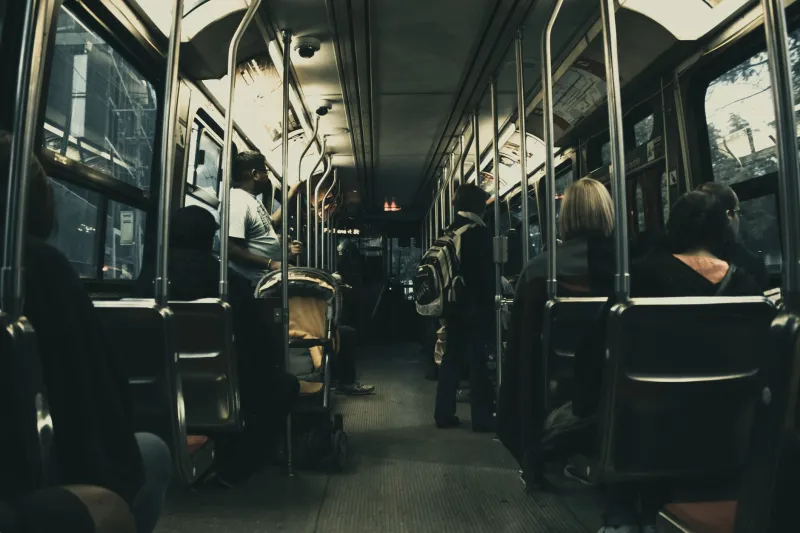
Here's what's easy to miss when we talk about old commutes: people adapted. They read newspapers — physical broadsheets folded with practiced expertise to fit the cramped space of a packed streetcar. They slept. They talked to strangers, which was not only acceptable but expected. Commuter culture was social in a way that's almost unrecognizable today.
Regular riders on the same route knew each other. Friendships formed on the 7:15 crosstown. Card games happened on commuter rail lines. Men played chess on folding boards balanced on their knees. The commute was, in a strange way, a shared civic experience — everyone in the same boat, sometimes literally.
This was also, it's worth noting, a period when working-class Americans had essentially zero private space during their day. Home was crowded. Work was supervised. The commute was often the only unstructured time a person had. Some people guarded it fiercely.
The Interstate Changed Everything — Then Made It Worse
When President Eisenhower signed the Federal Aid Highway Act in 1956, it set off the most ambitious road-building project in human history. Within two decades, 41,000 miles of interstate highway connected American cities, and the promise was seductive: faster travel, easier commutes, freedom.
And initially, it delivered. Driving from suburb to city on a new freeway was dramatically faster than the old multi-transfer transit journey. Families moved outward, chasing cheaper land and bigger homes. Developers built subdivisions in places that had been farmland five years earlier. The car became not just a convenience but a requirement.
The paradox, which urban planners now discuss exhaustively, is that all of this speed eventually produced slower commutes. As suburbs expanded, the distances grew. As roads widened to accommodate more cars, more cars arrived to fill them — a phenomenon called induced demand that highway engineers understood poorly in the 1960s and acknowledge ruefully today. The average American commute today is about 27 minutes each way, which sounds modest until you realize it's longer than it was in the 1980s, despite dramatically faster roads.
The worker who took a streetcar eight miles in 45 minutes in 1925 is, in terms of raw commute time, not that far behind the suburban driver crawling 22 miles on a congested interstate in 2024.
What Got Lost When the Streetcar Died
The dismantling of American streetcar networks is one of the most debated chapters in urban history. General Motors, Firestone, and Standard Oil were found guilty in 1949 of conspiring to replace electric transit with buses — though historians argue about how decisive that conspiracy actually was versus the organic pull of car culture and federal highway subsidies.
What's not debatable is the result. By the 1960s, most American cities had gutted their streetcar systems. The walkable, transit-connected neighborhoods those systems supported gradually hollowed out. The car became mandatory. And the commute — once a shared, social, human experience — became a solitary one, each driver sealed in their own metal box, alone with the radio.
The Commute as a Mirror
How a society moves its workers from home to job says something real about its values and its priorities. The pre-highway American commute was slow and often uncomfortable, but it was woven into community life. The modern commute is faster in theory but often lonelier in practice — and increasingly, many Americans are questioning whether the daily pilgrimage is worth it at all.
Remote work, which exploded after 2020, has given millions of Americans something their great-grandparents never had: the option to skip the commute entirely. Whether that's progress or loss probably depends on how much you enjoyed the card game on the 7:15.