Before CSI, Criminals Walked Free Because Science Hadn't Been Invented Yet
Before CSI, Criminals Walked Free Because Science Hadn't Been Invented Yet
Every week, millions of Americans watch crime shows where investigators solve murders using DNA analysis, fingerprint databases, and sophisticated forensic techniques. These technologies seem so fundamental to criminal justice that it's hard to imagine solving crimes without them. But for most of American history, police work was essentially educated guessing backed by intimidation.
When Your Word Against Theirs Was Literally All They Had
Before the 20th century, American criminal investigations relied on exactly three types of evidence: eyewitness testimony, confessions, and catching someone red-handed. That was it. No scientific analysis, no physical evidence processing, no forensic laboratories. If nobody saw the crime happen and the suspect didn't confess, cases simply went unsolved.
This system was catastrophically unreliable. Eyewitness accounts, we now know, are notoriously inaccurate even under ideal conditions. People misremember details, unconsciously alter their stories, and can be influenced by leading questions. In the chaos of a crime, witnesses often provided completely contradictory accounts of the same event.
Confessions were even more problematic. Police extracted them through methods that would horrify modern Americans: physical beatings, psychological torture, and threats against family members. Innocent people confessed to crimes they didn't commit simply to end the suffering. Guilty parties who could withstand interrogation walked free.
The Miracle of Unique Fingerprints
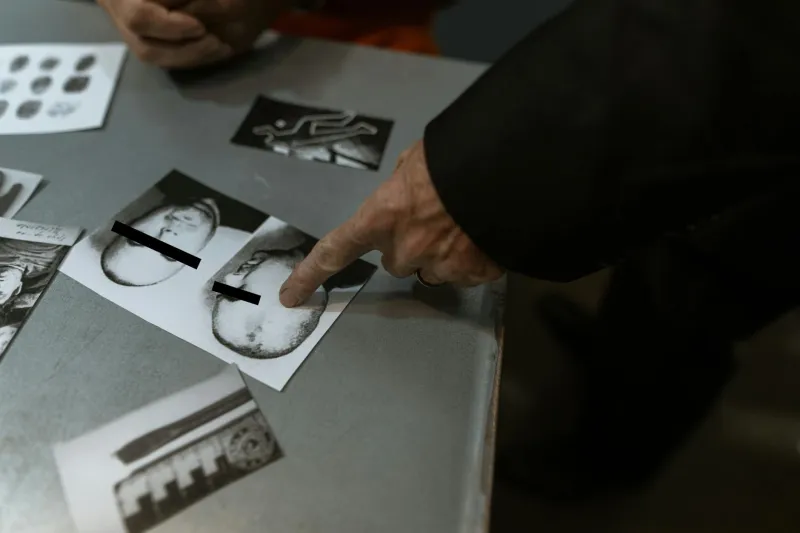
Everything began changing in 1902 when New York's civil service system started using fingerprints for identification. The concept seems obvious now, but it was revolutionary: every human being possessed a completely unique identifier that they couldn't alter or disguise.
Early fingerprint analysis was painfully slow and manual. Investigators had to visually compare prints against filing cabinets full of cards, searching for matches that might not exist. A single comparison could take hours, and large-scale searches were practically impossible.
Still, fingerprinting solved cases that had baffled investigators for decades. The 1904 murder of the Stratton brothers in London was the first case solved primarily through fingerprint evidence, proving that this new science could identify killers with mathematical certainty rather than educated guesswork.
Blood Types: The First Genetic Detective
By the 1920s, investigators discovered they could determine blood types from crime scene samples. This seems primitive now, but it was revolutionary then. For the first time, physical evidence could definitively exclude suspects or suggest their involvement.
Blood typing was crude compared to modern DNA analysis. There were only four basic blood types, meaning that matching blood could narrow suspects but rarely identified them conclusively. Still, it represented the first time American criminal justice could use genetic information to solve crimes.
Investigators learned to analyze blood spatter patterns, determining the height and angle of attacks. They could distinguish between different types of wounds based on bleeding patterns. What had once been simply "blood at the crime scene" became a complex source of information about exactly what happened.
The Photography Revolution
Crime scene photography, introduced in the 1880s, transformed how investigators preserved evidence. Before cameras, police relied on written descriptions and rough sketches to document crime scenes. Crucial details were lost, witness memories faded, and evidence was contaminated or destroyed.
Photography allowed investigators to study crime scenes long after they'd been cleaned up. They could examine evidence multiple times, share information between departments, and present visual proof in courtrooms. The camera became the ultimate objective witness — one that couldn't be intimidated, bribed, or confused.
When DNA Analysis Made Everything Else Look Like Guesswork
The introduction of DNA analysis in the 1980s made previous forensic techniques seem almost medieval. Suddenly, investigators could identify suspects from microscopic biological samples with near-perfect accuracy. A single hair, drop of saliva, or skin cell could conclusively link someone to a crime scene.
DNA analysis revolutionized cold cases. Murders that had gone unsolved for decades were suddenly solvable using evidence that had been sitting in storage rooms. The technology was so powerful that it not only solved new crimes but began exonerating people who had been wrongly convicted based on earlier, less reliable methods.
The Innocence Project has used DNA evidence to exonerate over 375 people who were wrongly convicted, including many who spent decades on death row. These cases reveal how unreliable pre-DNA criminal justice really was — and how many innocent people suffered because the science didn't exist yet.
The Database Revolution
Modern criminal justice doesn't just analyze individual pieces of evidence — it compares them against massive databases containing millions of records. CODIS, the FBI's DNA database, contains profiles from over 20 million individuals. Fingerprint databases can search millions of records in seconds.
This interconnected system means that a crime committed in California can be solved using evidence from a case in New York, or that a cold case from 1985 can be cracked by DNA from a suspect arrested yesterday. The collective power of shared information has transformed law enforcement from a local guessing game into a national scientific enterprise.
The Cases That Haunt History
Knowing what we know now about forensic science makes historical cases deeply troubling. How many innocent people were executed based on unreliable eyewitness testimony? How many guilty parties escaped justice because the technology to catch them didn't exist yet?
The Salem Witch Trials, the Scottsboro Boys, the Central Park Five — these cases remind us how recently American criminal justice was based on prejudice, fear, and scientific ignorance rather than objective evidence. Even well-intentioned investigators working within the system had no reliable tools to separate truth from fiction.
 Photo: Central Park, via centralpark.org
 Photo: Salem Witch Trials, via www.theconqueror.events
What We Take for Granted
When you watch crime shows or read about forensic breakthroughs, you're witnessing the culmination of barely a century of scientific advancement. The routine DNA analysis, fingerprint matching, and digital evidence processing that seem normal to us would appear miraculous to investigators from just 100 years ago.
Modern criminal justice isn't perfect, but it's built on scientific principles rather than guesswork and intimidation. That foundation — the idea that physical evidence should determine guilt or innocence rather than social prejudice or investigative hunches — is a recent innovation that previous generations of Americans never experienced.
The next time you see forensic analysis on television, remember: you're watching science fiction that became reality within living memory.