The Guy Who Knew Your Car's Soul: What We Lost When the Neighborhood Mechanic Disappeared
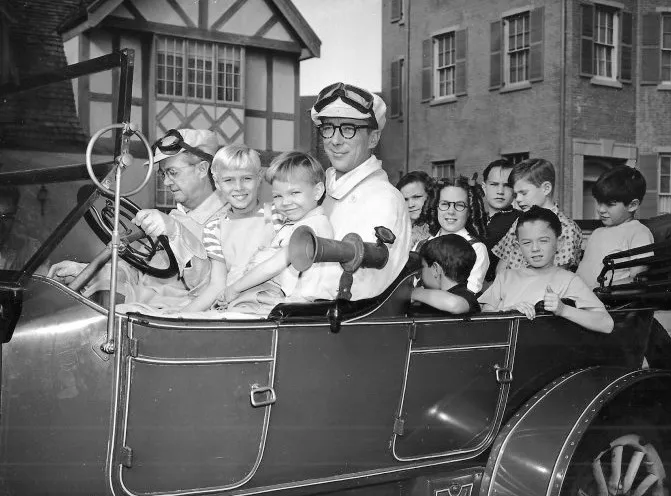
Photo: CBS Television, Public domain, via Wikimedia Commons
The Guy Who Knew Your Car's Soul: What We Lost When the Neighborhood Mechanic Disappeared
Here's a scene that's become almost impossible in modern America. You pull into a small garage on the edge of town. A guy in a worn denim shirt comes out, wipes his hands on a rag, and says, "She making that knocking sound again?" He doesn't need you to describe the problem. He's been working on your car for eleven years. He remembers that the previous owner had the same issue with the water pump. He'll fix it this afternoon, charge you a fair price, and wave when you drive away.
That relationship — personal, accumulated, built on years of mutual familiarity — is largely gone from American life. In its place is a system that is, by many measurable standards, more technically sophisticated and arguably more accurate. It is also colder, more expensive, and fundamentally harder to trust.
How that shift happened, and what it cost ordinary Americans, is a story worth telling carefully.
When Cars Were Comprehensible
The early automobile was, by modern standards, almost charmingly simple. A mechanic in the 1940s or 1950s working on a standard American car was dealing with a mechanical system that a sufficiently curious person could largely understand by looking at it. Carburetors, drum brakes, manual transmissions — these were physical, visible, logical systems. A skilled mechanic could diagnose problems by sound, by feel, and by experience. The job rewarded intuition and pattern recognition built up over years of hands-on work.
This simplicity meant that the barrier to entry for running a repair shop was relatively low. A mechanically gifted person with some tools and a rented garage space could establish a viable business. And because the cars themselves weren't dramatically different from one another in their fundamental architecture, a good mechanic could work competently on most of what drove through the door.
The result was a dense ecosystem of small, independent shops scattered across American towns and suburbs. These weren't just businesses — they were neighborhood institutions. The mechanic knew which families drove which cars, knew the quirks of local roads, and had usually been fixing vehicles for the same customers long enough to understand their driving habits. That accumulated context had real diagnostic value.
The Computer Took the Wheel
The transformation began gradually in the 1970s and accelerated sharply through the 1980s and 1990s. Federal emissions regulations required automakers to add increasingly sophisticated electronic control systems to their vehicles. The carburetor gave way to fuel injection. Mechanical ignition systems were replaced by electronic ones. Anti-lock brakes, airbag systems, and computerized transmission controls followed.
By the time the OBD-II standardized onboard diagnostic port became mandatory on all American vehicles in 1996, the modern car had become a rolling computer network. Today's vehicles contain dozens of electronic control units managing everything from engine timing to seat positioning, communicating over internal networks that bear more resemblance to a corporate IT infrastructure than to anything a 1950s mechanic would recognize.
This created a hard technical barrier. Diagnosing modern vehicle problems often requires specialized scan tools that can cost tens of thousands of dollars, plus ongoing software subscriptions to access manufacturer data. The independent shop that could survive on hand tools and experience was increasingly squeezed out by capital requirements it couldn't meet.
Franchise chains and dealership service departments — with their corporate purchasing power and standardized tooling — filled the gap. The result was consolidation. The guy in the denim shirt couldn't keep up, and in many communities, he stopped trying.
The Hidden Cost of Complexity
None of this means modern car repair is worse in a purely technical sense. Computerized diagnostics can identify problems with a precision that no amount of human intuition could match. Electronic systems have made vehicles dramatically more reliable — the average American car today lasts far longer than its 1970s equivalent. Competence, in a narrow technical definition, has genuinely improved.
But something else has been lost that doesn't show up in reliability statistics. When you drop your car at a dealership service department, you are almost certainly talking to a service advisor whose job is sales, not diagnosis. The actual technician may be excellent or may be a recent hire still working through a certification program. You have no way to know. The relationship that once provided a natural check on overcharging and unnecessary repairs — because your mechanic knew you'd be back, and knew you'd tell your neighbors — has been replaced by a transaction with a corporation that has no particular stake in your long-term satisfaction.
Repair costs have climbed steeply as a result, and not only because of parts prices. Labor rates at dealerships and franchise chains regularly exceed $150 per hour in major American cities. Diagnostic fees — charges just for connecting the scan tool and reading the codes — can run $100 to $200 before any actual work begins. And the opacity of the process, in which most customers genuinely cannot evaluate whether a recommended repair is necessary, creates conditions that are structurally favorable to overservicing.
What a Few Places Still Get Right
The independent mechanic hasn't entirely vanished. In smaller cities and rural communities, shops that operate on the old model still exist — often run by people who built their reputations over decades and whose customer base is loyal precisely because the relationship still functions the way it used to. These shops have adapted, investing in modern diagnostic equipment while maintaining the personal accountability that corporate chains structurally cannot replicate.
The difference is immediately apparent to anyone who has experienced both. An independent mechanic who tells you that a repair can wait another six months, or that the dealership's recommendation is unnecessary, is giving you information that has real value — and is doing so because their business depends on your continued trust, not on this quarter's service revenue.
A Pattern Bigger Than Cars
The disappearance of the neighborhood mechanic is, in the end, a specific version of a much broader shift in American life. The trusted local expert — the family doctor, the corner pharmacist, the independent financial advisor who knew your whole situation — has been systematically replaced by systems that are more scalable and more technically sophisticated but that treat you, fundamentally, as a transaction.
Efficiency was gained. Something harder to quantify was surrendered. And most of us only notice what we gave up when something breaks down — literally, in this case — and we realize we have no one to call who actually knows our car, or us, at all.