Cake, Balloons, and Six Kids From the Block: The Birthday Party Before It Became a Production
Cake, Balloons, Six Kids From the Block: The Birthday Party Before It Became a Production
There's a particular kind of birthday party photograph that surfaces constantly in old family albums. A kid in front of a cake, candles lit, a handful of neighborhood children crowded around a kitchen table. Paper plates. A banner someone made with construction paper. Maybe a bag of chips in the corner. Everyone is smiling. The party lasted two hours and cost roughly nothing.
Now open Instagram and search "kids birthday party." What you find looks like a different civilization entirely.
What a Birthday Used to Look Like
For most of the 20th century, American birthday parties for children were genuinely simple affairs. Through the 1950s, 60s, and into the 70s, the typical celebration involved inviting the kids who lived nearby, serving homemade cake — baked from scratch or, later, from a box — and playing backyard games that required no equipment beyond what was already in the garage. Pin the tail on the donkey. Freeze tag. Musical chairs with a record player.
Gifts were modest. A toy, a book, a game. The expectation wasn't abundance; it was presence. The child was the center of attention for an afternoon, blew out candles, got sung to, opened some presents. That was the whole thing. Parents didn't photograph every moment. No one live-streamed the cake cutting. The party existed in real time, for the people who were actually there, and then it was over.
Costs were negligible by any measure. A homemade cake ran a few dollars in ingredients. Streamers and balloons were purchased at the five-and-dime. Lemonade from a powder mix. The financial burden of a child's birthday party simply wasn't a meaningful category of household spending.
The Commercialization of Celebration
The shift didn't happen overnight, but the 1980s marked a meaningful turning point. Chuck E. Cheese opened its first locations in the late 1970s and expanded aggressively through the 80s, offering something that had barely existed before: a venue purpose-built for children's birthday parties. For a set price, you got a private room, pizza, tokens for the games, and an animatronic band performing in the dining area. Parents didn't have to clean up. They didn't have to plan activities. They just showed up and paid.
It was genuinely convenient, and it proved something important to the party industry: parents would pay for ease. That insight, once established, never went away.
Through the 1990s, the party venue industry exploded. Bounce house facilities, pottery painting studios, gymnastics gyms, laser tag arenas — all offered birthday party packages. The message embedded in each one was subtle but consistent: a real party happens somewhere, with something organized, with a professional running it. A party at home started to feel, to some parents, like cutting corners.
The Instagram Effect
Social media finished what the party industry started. When birthday celebrations became photographable, shareable content, the aesthetic stakes transformed entirely. A simple sheet cake became a fondant-covered custom creation ordered from a specialty bakery. Balloons became balloon arches, balloon walls, elaborate installations requiring professional setup. Favor bags went from a handful of candy to curated gift boxes with personalized labels.
The "theme" became mandatory. Not just a color scheme — a fully realized concept. Dinosaurs, but make it cohesive. Every detail matching, from the plates to the napkins to the custom banner to the smash cake (a separate small cake, for the photographs of the baby destroying it). The party had to tell a visual story that would perform well in a grid.
Parenting forums and social media groups are full of parents — often exhausted, often ambivalent — confessing that they spent $800, $1,200, $2,000 on a five-year-old's birthday party. Not for a celebrity child. For an ordinary kid in an ordinary American suburb who, by most accounts, would have been equally happy with balloons and pizza.
What the Numbers Say
The children's party industry in the United States now generates billions of dollars annually. Party planning services, custom cakes, entertainment packages, venue rentals, and party supply retail represent a substantial and growing market. One survey found that American parents spend an average of $400–$500 on a child's birthday party — and that figure skews much higher for parents in higher income brackets or in major metro areas, where social comparison pressure is intense.
For context, adjusted for inflation, a 1970s birthday party might have cost the equivalent of $30–$50 in today's dollars. The increase isn't explained by quality of experience. Children at simple backyard parties in old home videos look, by every observable measure, exactly as happy as children at elaborate theme park celebrations.
The Pressure Nobody Admits To
What's driving the spending isn't really the children. Kids don't arrive at age five with opinions about balloon arch aesthetics. The pressure is social, adult, and largely unspoken. Parents worry that a modest party will seem like insufficient love. They worry their child will feel slighted compared to classmates whose parties were bigger. They worry about what other parents will think.
The commercial party industry didn't create these anxieties — it identified them and built an entire economy around them. Every upgraded package, every add-on, every "premium experience" is sold against the implicit fear of doing too little.
The Kids Are Fine Either Way
Child development researchers are fairly consistent on this point: children's memories of birthday parties center on feeling celebrated, not on the scale of production. The emotional core — being sung to, blowing out candles, being surrounded by people who love them — is identical whether the cake cost $12 or $350.
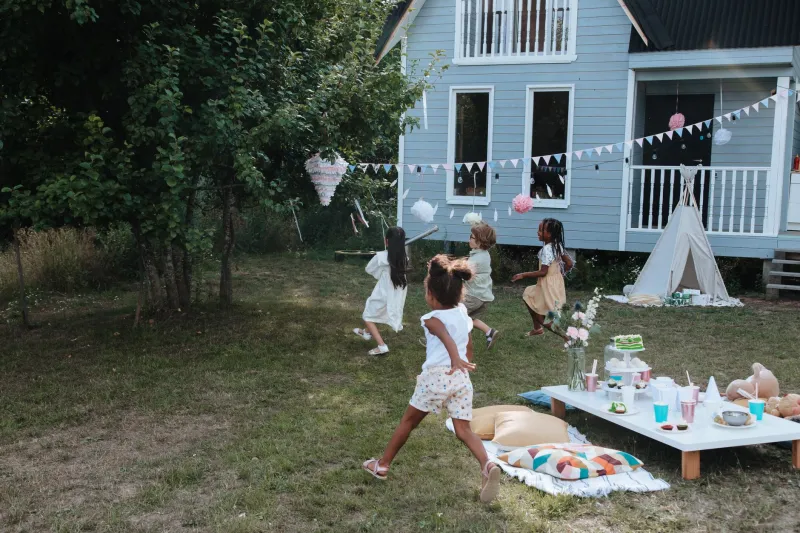
Some parents are pushing back. The "simple party" has become its own quiet trend, with families consciously choosing to scale down and discovering that their kids don't notice the difference. A few balloons, a backyard, a homemade cake, some neighborhood kids. The kind of party that used to just be called a party.
It turns out that was enough all along.