When Raising a Barn Meant Raising a Community: How American Homebuilding Lost Its Soul
Picture this: It's 1880 in rural Ohio, and the Millers need a new barn. Word spreads through the township, and come Saturday morning, twenty families arrive with their tools, their skills, and covered dishes for the midday meal. By sunset, the Millers have a barn—and the community has another excuse to gather, share stories, and strengthen the bonds that hold their world together.
Now imagine explaining to those farmers that in 2024, building a home requires permits from six different government agencies, materials sourced from three different continents, and a construction crew of strangers who communicate primarily through text messages.
The Age of Community Construction
For most of American history, building a home was fundamentally a social act. The famous "barn raising" wasn't just a quaint rural tradition—it was economic necessity wrapped in community spirit. When the Hendersons needed a house, the whole neighborhood understood they might need the same favor returned someday.
Local craftsmen knew every family in town and their specific needs. The blacksmith who forged your door hinges also shod your horses. The carpenter who framed your walls had probably shared Sunday dinner at your table. Materials came from the local sawmill, which sourced timber from the surrounding forest. Even the nails were likely forged by someone you knew personally.
Cost wasn't measured purely in dollars—it was calculated in favors, shared labor, and mutual obligation. A skilled carpenter might frame your house in exchange for help harvesting his crops. The local mason might build your chimney for a side of beef and the promise of assistance when his own family needed a hand.
When Everything Changed
The transformation began quietly in the 1920s, accelerated through the post-war suburban boom, and reached full velocity by the 1980s. Mass production techniques that had revolutionized automobile manufacturing suddenly applied to housing. Why have local craftsmen hand-cut each beam when you could mass-produce standardized components in distant factories?
The rise of suburban developments marked the death of neighborhood construction. Levittown, the massive planned community built on Long Island after World War II, demonstrated a new model: identical homes built by specialized crews using standardized plans and factory-made components. Efficiency replaced craftsmanship. Speed trumped community.
 Photo: Long Island, via www.longislandpress.com
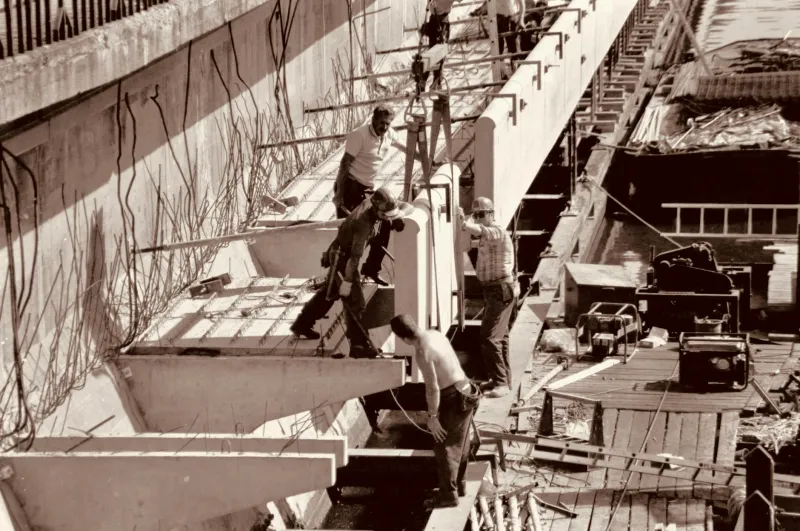
By the 1990s, major homebuilders operated like assembly lines. Different crews handled different phases—foundation specialists, framing teams, electrical contractors, plumbers—each appearing for their specific task before moving on to the next development. The idea of neighbors gathering to help build a house became as outdated as churning your own butter.
The Modern Housing Machine
Today's homebuilding process would mystify those 1880s farmers. Before a single nail gets hammered, you'll navigate months of permit applications, environmental impact studies, and zoning approvals. Your local building department may require plans stamped by licensed engineers for what those farmers would have sketched on the back of an envelope.
The materials in your modern home traveled thousands of miles to reach your lot. Lumber from Canadian forests, fixtures manufactured in China, appliances assembled in Mexico. The workers building your house may speak three different languages and drive hours each day to reach the construction site.
Your relationship with the actual builders? Essentially nonexistent. You'll interact with a sales representative, maybe a project manager. The electrician installing your outlets doesn't know your name and will never see you again after move-in day.
The financial structure has transformed completely too. That $450,000 starter home requires a 30-year mortgage, property insurance, title insurance, inspection fees, and closing costs that would have funded an entire neighborhood in 1880. What once cost a few months of shared labor now demands decades of monthly payments.
What We Gained and Lost
Modern construction delivers undeniable advantages. Today's homes are safer, more energy-efficient, and built to stricter standards than anything those community barn-raisings could produce. Your electrical system won't burn the house down, your plumbing includes hot water on demand, and your foundation will last centuries.
But something intangible vanished in the transition. When your neighbors built your house, they had a stake in its quality—they'd see it every day and face you at church if something went wrong. When strangers build your house according to minimum code requirements, the relationship ends at final inspection.
The shift from community construction to corporate homebuilding mirrors a broader transformation in American life. We gained efficiency, standardization, and technical sophistication. We lost the deep connections that came from depending on each other for life's essential needs.
The Price of Progress
Those 1880s farmers would be stunned by our modern homes—the climate control, the instant hot water, the electrical outlets in every room. But they might be equally puzzled by the isolation of the process, the way we've turned one of life's most fundamental needs into a purely commercial transaction.
In their world, building a home strengthened community bonds and created lasting relationships. In our world, it's a complex financial product delivered by strangers. Both approaches get you a roof over your head, but only one left you feeling more connected to your neighbors when it was finished.
The barn-raising may be gone forever, but its memory reminds us that efficiency isn't the only measure of progress. Sometimes the old way of doing things built more than just houses—it built communities that could weather any storm together.