The Dentist Who Showed Up at Your Front Door With a Black Bag and a Prayer
Picture this: it's 1910, your back molar has been throbbing for a week, and the solution isn't scheduling an appointment at a sterile clinic down the road. The solution is waiting for a man to show up at your house — sometimes unannounced, sometimes by postcard — unpack a leather bag on your kitchen table, and get to work while your family quietly clears the room.
This was American dental care for a significant stretch of the early twentieth century. And most of us have completely forgotten it ever happened.
The Traveling Dentist Was a Real Thing
In rural and small-town America, dedicated dental offices were a luxury that simply didn't exist everywhere. Trained dentists — and plenty of self-trained ones — traveled circuits through towns and counties, setting up temporary operations wherever they could find a flat surface and decent light. Hotels, barbershops, general stores, and private homes all served as impromptu treatment rooms.
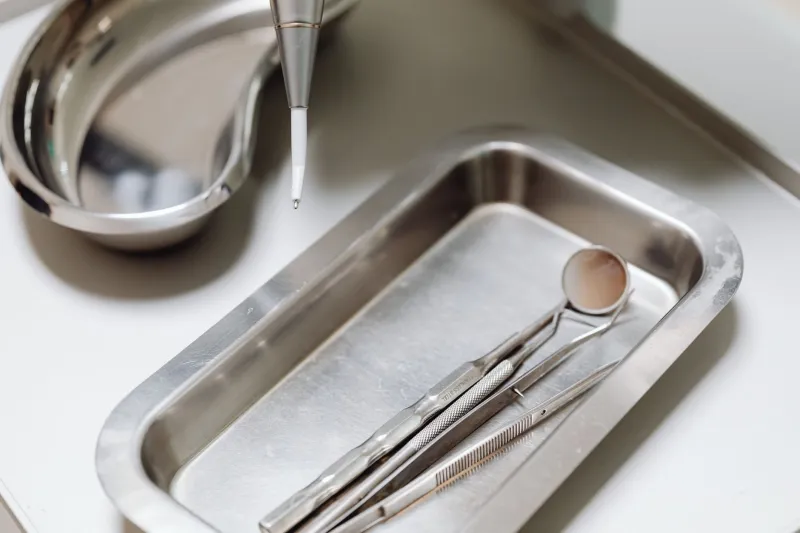
The equipment they hauled was genuinely impressive for its time, and genuinely terrifying by any modern standard. Portable foot-pedal drills. Forceps in various alarming sizes. A hand mirror. A small spirit lamp for sterilization — though "sterilization" was a generous term for what was actually happening. Some traveling dentists carried early versions of the reclining chair, fold-up contraptions that could be set up in a parlor or a back room. Many just used whatever chair the household had available.
The work they performed was almost entirely extraction. Fillings existed, but drilling without reliable anesthesia was a negotiation most patients weren't willing to enter. If a tooth hurt badly enough, it came out. The threshold for pulling a tooth was dramatically lower than anything we'd recognize today, which is part of why photographs of Americans from this era so often reveal missing teeth as a quiet, unremarkable fact of life.
Pain Management Was Largely a Suggestion
Anesthesia in early twentieth-century dentistry was inconsistent at best. Cocaine solutions had been used as a local anesthetic since the 1880s, and novocaine arrived in 1905, but distribution to traveling practitioners was uneven. Whether you got anything for the pain often depended entirely on who showed up at your door and what they happened to be carrying that week.
Whiskey was a genuine part of the toolkit for some practitioners. Distraction was another — some dentists were known for their ability to talk continuously through a procedure, keeping the patient's attention elsewhere long enough to finish the job. Speed was considered a professional virtue. A dentist who could pull a molar in under thirty seconds was a dentist who got recommended to neighbors.
The infection risk that followed procedures was treated with roughly the same casualness as the procedures themselves. Patients were told to rinse with salt water, avoid cold drafts, and rest. Whether they developed post-extraction infections was largely a matter of luck.
The Storefront Dentist Wasn't Much Better
For those who lived near enough to a town center to access a fixed dental office, the experience wasn't dramatically more sophisticated. Early twentieth-century dental practices operated without the infection control protocols, sterilized instrument packaging, or procedural standards that modern patients take entirely for granted.
The dental chair existed and was becoming standard equipment, but the room surrounding it might be shared with a barbershop, a doctor's general practice, or a pharmacy. X-ray technology existed after the 1890s but was expensive, poorly understood in terms of radiation risk, and far from universal. Dentists made diagnoses primarily by poking at teeth and listening to patients describe their pain.
Dental school training varied enormously. Some practitioners had rigorous educations. Others had apprenticed briefly with an existing dentist and hung a shingle. The licensing standards that now govern dental practice in every state were patchwork and unevenly enforced for much of the early century.
What Changed Everything
The transformation of American dentistry into the experience most of us know today happened in stages across the mid-twentieth century. Fluoridation of public water supplies, beginning in the 1940s, reduced cavity rates dramatically across the population. Dental insurance became more common through employer benefits packages in the postwar decades, making regular checkups financially accessible to more families.
Antibiotic availability after World War II changed the risk calculus around dental procedures entirely. Procedures that had carried serious infection risk became routine. The professionalization of dental education standardized training requirements. And the development of modern anesthetic delivery — the fine-gauge needle, the buffered solution, the precise dosing — turned the dreaded injection into something most patients barely notice.
Today's dental visit takes place in a room where every instrument has been autoclaved, where digital imaging can reveal problems invisible to any probe, where a dentist can discuss options ranging from a simple filling to a ceramic crown placed in a single appointment. Sedation dentistry exists for patients with severe anxiety. Pain management is so effective that many patients report feeling nothing at all.
The Gap Is Staggering When You Look at It Directly
It's easy to complain about dental costs, waiting room magazines, and the mild indignity of having someone's hands in your mouth for forty-five minutes. Those complaints are valid. But the distance between a traveling dentist pulling a molar at your kitchen table with a foot-pedal drill and no reliable anesthesia — and a modern endodontist performing a root canal while you listen to a podcast — is almost incomprehensibly large.
The traveling dentist with his black bag wasn't a villain. He was often the only option available, doing his best with the tools and knowledge his era provided. But his era was genuinely hard in ways that are easy to forget when a cleaning appointment feels like an inconvenience.
Your kitchen table has seen a lot. Hopefully, nothing like that anymore.